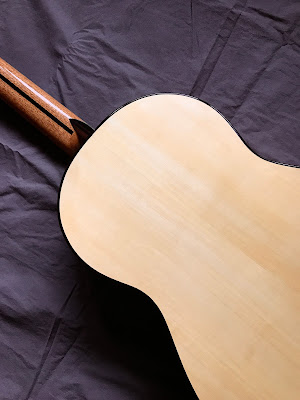
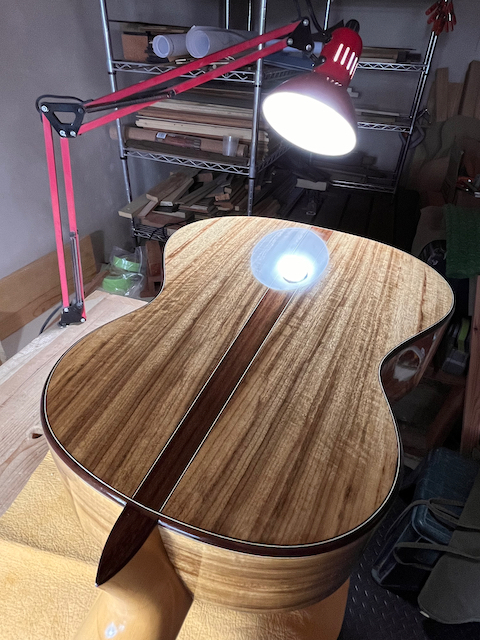
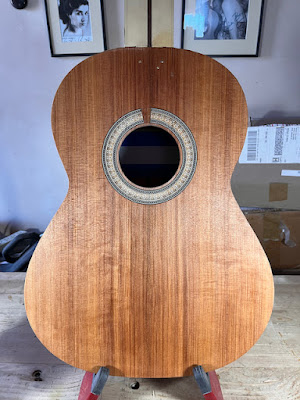
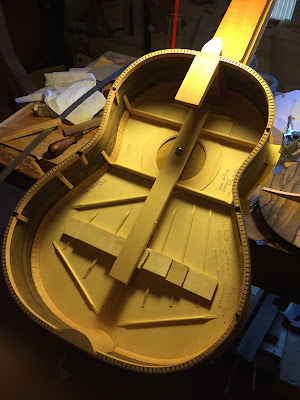
This is a concert size ukulele (oo koo lay le, if you want to sound Hawaiian, I prefer the American English of you ka' lay lee), the top is reclaimed redwood from a redwood water tank and the back, sides and headpiece veneer are the last of the walnut from a tree my grandfather planted back in 1941. The neck is Spanish cedar, the binding and bridge will be ebony. I hope to finish construction soon, it will take a while to do the French polish.
Sunday, June 28, 2009
Ukulele #1, Redwood and Walnut
2 photos of a ukulele that I am working on. I decided that I wanted a little guitar to play when we drive to Colorado this September, what better than a ukulele. It's gone together remarkably fast compared to a full size classic guitar, its small size lends to the ease of construction. The chunk of wood that you see glued on the bass side of the neck is a patch where the router went amok when I was making the binding channels.

This is a concert size ukulele (oo koo lay le, if you want to sound Hawaiian, I prefer the American English of you ka' lay lee), the top is reclaimed redwood from a redwood water tank and the back, sides and headpiece veneer are the last of the walnut from a tree my grandfather planted back in 1941. The neck is Spanish cedar, the binding and bridge will be ebony. I hope to finish construction soon, it will take a while to do the French polish.
Tuesday, April 28, 2009
Half Dome and Tunnel View at Yosemite NP
In almost every granitic mountain range (but especially in the Sierra Nevada of California) enormous, astounding hemispheres of naked stone-called domes, appropriately-stand above the surrounding terrain to catch the eye and fuel the imagination.
Jon Krakauer, Home Ground, Language for an American Landscape, 2006

We went to the park 2 weeks ago, stopped at the Yosemite Sugar Pine Railroad, (what a blast) and then braved the traffic into Yosemite Valley. It was the Saturday at the end of spring break, talk about a traffic jam. Yosemite is the Hyde Park of the West.

On the way to the valley I just had to stop and take another photo from the Tunnel View. It is always a great spot to people watch, that day there were alot of Asian Indian families there, all the men were in their business suits. If you love to look at waterfalls, now is the time to be in Yosemite. The spring runoff is going great guns and all the valley waterfalls are running full, and there are not that many people in the park. I spent the last 2 weeks working at Curry Village putting shakes on the Curry Village Lounge and everybody is surprised at how few people there are in the park.
Jon Krakauer, Home Ground, Language for an American Landscape, 2006
We went to the park 2 weeks ago, stopped at the Yosemite Sugar Pine Railroad, (what a blast) and then braved the traffic into Yosemite Valley. It was the Saturday at the end of spring break, talk about a traffic jam. Yosemite is the Hyde Park of the West.
On the way to the valley I just had to stop and take another photo from the Tunnel View. It is always a great spot to people watch, that day there were alot of Asian Indian families there, all the men were in their business suits. If you love to look at waterfalls, now is the time to be in Yosemite. The spring runoff is going great guns and all the valley waterfalls are running full, and there are not that many people in the park. I spent the last 2 weeks working at Curry Village putting shakes on the Curry Village Lounge and everybody is surprised at how few people there are in the park.
Thursday, April 9, 2009
Guitars and Porches
Sorry for the time away from the blog, lots going on, the online class I am taking takes alot of free time, deed, census searches, etc.

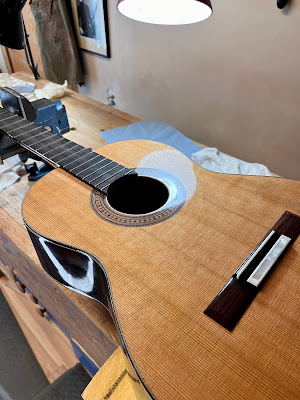
Every now and again I actually make it into the shop and work on a guitar. Several weeks ago I routed out rosette channels for the Simplicio style double soundhole guitar and I need to update with new photos of that guitar top, because I installed the inlay of curly redwood burl. This photo shows my hand holding the top to drill holes for the router index pin.

The porch has been poured at #705. From left is Marty, Rod, Randy and Casey. Now we are ripping cedar shingles down to 5 and 1/2 inches to nail on to the exterior walls at the Curry Village registration building in Yosemite Valley. My eyes got crossed today from ripping the shingles, it is a very monotonous task.
Every now and again I actually make it into the shop and work on a guitar. Several weeks ago I routed out rosette channels for the Simplicio style double soundhole guitar and I need to update with new photos of that guitar top, because I installed the inlay of curly redwood burl. This photo shows my hand holding the top to drill holes for the router index pin.
The porch has been poured at #705. From left is Marty, Rod, Randy and Casey. Now we are ripping cedar shingles down to 5 and 1/2 inches to nail on to the exterior walls at the Curry Village registration building in Yosemite Valley. My eyes got crossed today from ripping the shingles, it is a very monotonous task.
Friday, February 6, 2009
How to Lift a House
Here we are, once again at #705 in El Portal. This is the formal entrance of the building, one corner of the house is pretty much rotted and Derek and I needed a way to suspend this side of the house while we dug a trench to pour a footer.
We knew that we needed to sling the rim joist, but how to hold the beam that would carry the chain hoists and a come-along. One of the guys at work suggested that we use A-frames to hold a beam. I really liked the idea and built them. The middle beam sports a 2-ton come-along where we have slung the cable through the sling to double its lifting capacity, the other two beams have 3/4 ton chain hoists attached to the sling. The slings wrap around the rim joist and I had Derek ratchet the hoists as much as he could, we were able to put a half inch crown in the middle of the joist.
This is Derek, the man with no face. He leaves next week to go work for the US Forest Service to be a firefighter, I wish him good luck. This photo shows you how we stabilized the ends of the beams, what this photo doesn't show you is the bend we put into the beam.
Saturday, December 27, 2008
Martinez Guitar, ca. 1816
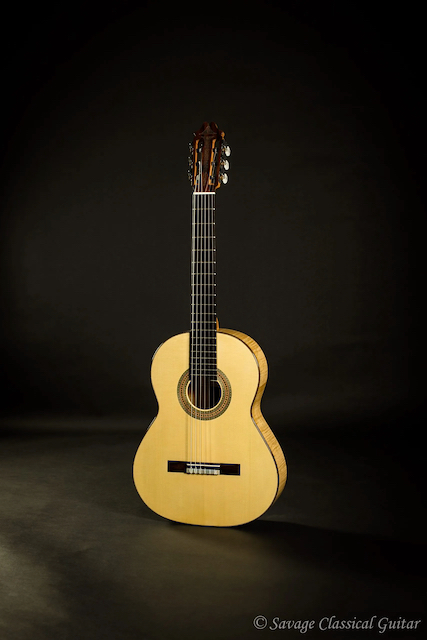
A guitar based upon an ca. 1816 Jose Martinez guitar, original signed by Fernando Sor.

The bridge is not a copy on the original, it is a "modern" bridge. It is made from rosewood and is fitted with an ebony saddle. The guitar is loud and sweet sounding with this saddle.
Douglas fir top, maple back and side, Spanish cedar neck. 614 mm string length.

A joy to play, it's voice surrounds you.
The bridge is not a copy on the original, it is a "modern" bridge. It is made from rosewood and is fitted with an ebony saddle. The guitar is loud and sweet sounding with this saddle.
Douglas fir top, maple back and side, Spanish cedar neck. 614 mm string length.
A joy to play, it's voice surrounds you.
Martinez and Lacote Guitars
As promised, a photo of the Martinez and Lacote guitars.

I strung the Martinez with light tension D'Addario strings and installed an ebony nut and saddle, the guitar sounds wonderful. I have been playing alot of Giuliani's music on it and sight read through Sor's famous theme and variations on a tune of Mozart. The music makes more sense, fingering wise, on a small guitar.
Thursday, September 25, 2008
Slotting a Fretboard and New Tool Chest
Ideally, the work bench should be situated near a large window that gathers north light.
Irving Sloane, Guitar Repair, 1973
I recently purchased a new fret saw from Stew-Mac, my old saw was getting very dull and I am having a difficult time in finding a saw sharpening business that is willing to resharpen it. The new saw arrived with the saw blade reversed so that the teeth would cut on the pull stroke, which is fine if the teeth are shaped like those on a Japanese pull saw. Western style teeth were designed to be cut on the pull stroke. Anyway, I used the saw as it came to me and I failed miserably with it, all the slots were terribly angled off perpendicular to the fret board, I wasted a $20 piece of ebony. My solution was to tap the saw blade out of the brass back spline and replace it so that the teeth cut on the push stroke. This gave me much more control.

However, even after doing that and using the block setup that you see in the above photo, I still had the problem of the blade cutting slightly off of perpendicular.

In this photo you can see how I held the saw blade against the block with my fingers making a "galoot" miter box. I managed well with this system, but was perplexed about the saw's cutting ability or lack thereof. I pulled out a set of calipers, I measured the thickness of the blade and the set of the teeth, both were the same measurement! When that happens on any saw the saw will binding in the kerf and make sawing difficult. Good handsaws, Disston, Simonds, Keen Cutter, etc., have hollow ground blades, where the "back" of the saw is ground thinner then the part where the teeth live. I measured my old slotting saw, purchased in 1992, and its blade is thinner then the set of the teeth.

What I have learned from this is that I have several options - 1.) I need to spend the money on a good Lie-Nielson saw and purchase the expensive slotting miter box from Luthiers Mercantile, 2.) I buy a slotting blade from Stew-Mac and put it on my table saw and make a slotting jig, 3.) I purchase all my finger boards already slotted, LMI does that for an additional $9 when you purchase a finger board. Hmm, not a bad idea!
I made a new tool chest for the move to Mariposa, it's loosely based on Duncan Phyfe's famous tool chest, mine isn't as large, I made the carcase out of birch plywood and I made seperate tills to hold my tools. I just have to make a lid, install handles and I am ready to go!
Irving Sloane, Guitar Repair, 1973
I recently purchased a new fret saw from Stew-Mac, my old saw was getting very dull and I am having a difficult time in finding a saw sharpening business that is willing to resharpen it. The new saw arrived with the saw blade reversed so that the teeth would cut on the pull stroke, which is fine if the teeth are shaped like those on a Japanese pull saw. Western style teeth were designed to be cut on the pull stroke. Anyway, I used the saw as it came to me and I failed miserably with it, all the slots were terribly angled off perpendicular to the fret board, I wasted a $20 piece of ebony. My solution was to tap the saw blade out of the brass back spline and replace it so that the teeth cut on the push stroke. This gave me much more control.
However, even after doing that and using the block setup that you see in the above photo, I still had the problem of the blade cutting slightly off of perpendicular.
In this photo you can see how I held the saw blade against the block with my fingers making a "galoot" miter box. I managed well with this system, but was perplexed about the saw's cutting ability or lack thereof. I pulled out a set of calipers, I measured the thickness of the blade and the set of the teeth, both were the same measurement! When that happens on any saw the saw will binding in the kerf and make sawing difficult. Good handsaws, Disston, Simonds, Keen Cutter, etc., have hollow ground blades, where the "back" of the saw is ground thinner then the part where the teeth live. I measured my old slotting saw, purchased in 1992, and its blade is thinner then the set of the teeth.
What I have learned from this is that I have several options - 1.) I need to spend the money on a good Lie-Nielson saw and purchase the expensive slotting miter box from Luthiers Mercantile, 2.) I buy a slotting blade from Stew-Mac and put it on my table saw and make a slotting jig, 3.) I purchase all my finger boards already slotted, LMI does that for an additional $9 when you purchase a finger board. Hmm, not a bad idea!
I made a new tool chest for the move to Mariposa, it's loosely based on Duncan Phyfe's famous tool chest, mine isn't as large, I made the carcase out of birch plywood and I made seperate tills to hold my tools. I just have to make a lid, install handles and I am ready to go!
Subscribe to:
Posts (Atom)